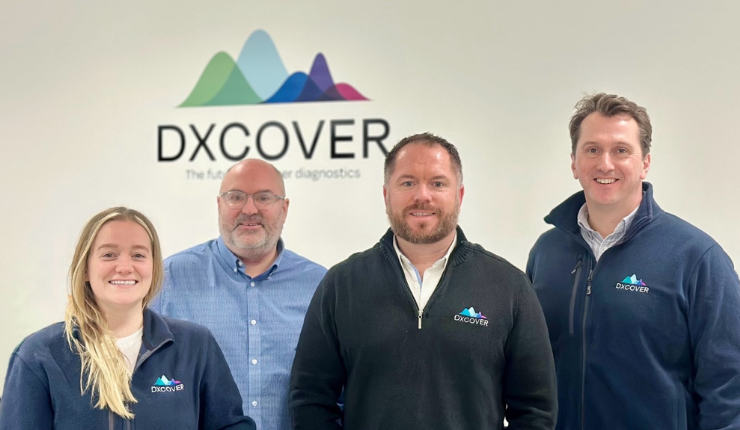
Editorial Content Producer Oli Johnson speaks to Dxcover’s Chief Executive Officer Professor Matthew J Baker about the company’s blood test that can detect brain cancer in its earliest stages.
Each year, around 167,000 people in the UK alone lose their lives to cancer. Brain cancer is the 10th most common type of cancer in the country, accounting for 3% of all cancer deaths (2017-2019). With brain cancer, there are challenges for doctors as the symptoms can often be vague, and the path to diagnosis is slow and can feature multiple brain scans. As a result, 38% of brain tumour patients in the UK make up to five visits to primary care before receiving a diagnosis according to Dxcover.
A study from by Cancer Research UK estimated that a four-week delay in cancer surgery could lead to a 6-8% increased risk of death, highlighting the importance of timely intervention. Dxcover says it believes the current situation with regards to testing and diagnosis needs ‘democratising’, with more people able to access results faster.
With blood tests developed by Dxcover, it is possible for a single test to detect brain cancer in its earliest stages says the company, sparing lives and potentially saving billions in healthcare costs.
The company recently received 6.2M USD in its latest funding round, being supported by a host of names including Macmillan Cancer Support, bringing its total funding to 21.4M USD since it spun out of the University of Strathclyde in 2019.
How does it work?
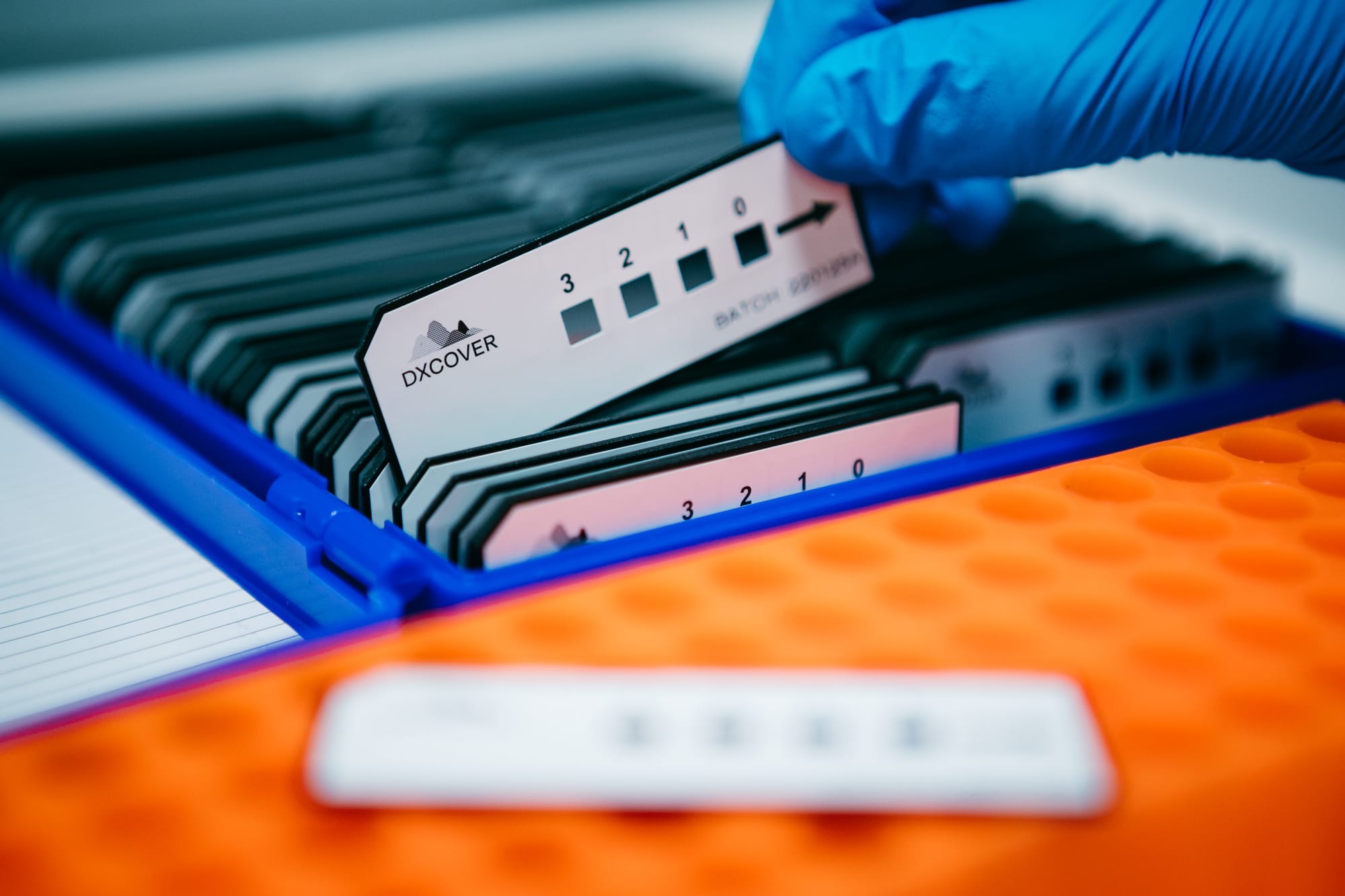
Dxcover’s PANAROMIC platform combines novel hardware with AI algorithms to analyse a patient’s blood and detect the presence or absence of disease. The platform uses infrared spectroscopy, a technique that has been used for decades.
Co-Founder and CEO, Professor Matthew J Baker told Med-Tech Insights: “We didn’t invent FTIR, but we’ve certainly made it clinically relevant. Our auto sampler enabled us to get through high levels of patient data and patient analysis, that when combined with the great strides made in artificial intelligence and machine learning enabled us to start to develop this new technique – MOSA-Dx.”
Baker also spoke about the role of the AI in the product: “The AI enables us to find the differences between cancerous and non-cancerous populations. We are able to train an algorithm to identify this difference and then we freeze that algorithm. Currently, we are using our brain cancer detection algorithm in the largest, to our knowledge, brain cancer diagnostic study that has ever been done. This is recruiting 2,200 patients across seven European sites.
“Those sites are Liverpool, Edinburgh, Preston, Leeds, Gothenburg, Zurich, and Antwerp. So once that’s completed, our algorithm has been properly tested. From that, we can apply for regulatory approval, which gives us the green light to start to commercialise and sell the test.”
Democratising cancer testing
Baker spoke to MTI about some of the statistics surrounding cancer diagnostics. In the United States, cancer is the number one cause of death in under 85s. A person is diagnosed every 1.6 seconds, which leads to around 26,000 deaths from cancer per day worldwide. Baker highlighted that 70% of those cancer deaths occur in lower socioeconomic populations. The CEO told MTI: “What we need to do is enable those populations to get the best possible care they can.”
What makes brain cancer more difficult to diagnose than other variations of the disease is the symptomology not being specific. There isn’t one symptom that a GP can point to and confirm that the patient has brain cancer. Brain cancer has more general symptoms such as headaches, and vomiting in the morning, which could be indicative of a range of different diseases.
This leads to a more convoluted pathway for patients, with around 38 to 40% of patients in the UK visiting their GP more than five times prior to the diagnosis of a brain tumour. Baker said: “That obviously leads to delays in diagnosis and the growth of the tumour as well. What we want to do is turn cancer into a chronic disease and enable patients to live full lives.
“There’s also a challenge on the families as well, because unfortunately, brain cancer in particular has the highest care and cost of all tumours, which means that families generally have to look after that family member which obviously has a big impact on their economics.”
Baker added: “Cancer diagnoses currently are occurring too late. We generally identify diseases at stage three or stage four, and we know that early diagnosis can save lives. What we want to do is move that diagnosis earlier in the chain and be able to start to save lives.”
Currently, there isn’t a technique that can detect sensitively cancer this early. A patient can go to a GP and have biomarkers measured, which can indicate signs of disease, but they aren’t detecting cancer early. There are also labs which used a cell-free DNA (cfDNA) technique, which looks for DNA from tumour cells; but not all tumours release DNA into the bloodstream. Gliomas, the most common primary brain tumours, are the least shedding of any tumour.
Baker told MTI: “If I was trying to take gliomas via a genomic technique, I wouldn’t be able to do it. So we need to be able to look at something different, and look at the biology differently, and that’s essentially what we do. We have an analysis that enables us to look across all the biology. It needs democratising or it needs moving out to the patient so that they can access it easier, instead of a confirmatory diagnostic which currently is a scan, an MRI or CT scan at a major hospital.”
The Dxcover team
The company began when a research group spun out of the University of Strathclyde in Glasgow, Scotland. The four Co-Founders are Prof. Baker, Dr. David S Palmer, Dr. Holly J Butler and Dr. Mark Hegarty. At Dxcover, Dr. Palmer holds the role of Chief Scientific Officer, Dr. Butler is Chief Technical Officer and Dr. Hegarty is an Advisor.
Dr. Hegarty led Dxcover as CEO for the first five-year plan after its spin-out. Baker said: “Mark is essentially a PhD level chemical physicist who’s worked in medical devices, but he was also a business head. He was a managing director of a company in Scotland, but was coming back to start-ups.”
Dr. Butler brings to the team over 12 years of experience in clinical spectroscopy, and is an experienced researcher in biophotonics and infrared analysis. Butler has received accolades such as ‘Young Entrepeneur of the Year’ at the Scottish Women’s Awards.
Dr. Palmer has over 20 years of experience in the field of data analysis and machine learning, leading the design and development of the Dxcover algorithms.